

Norwegian Forest Cat
The image on this page is AI-generated and does not depict a real animal.
- Species
- Cat
- Origin
- Norway
- Size
- Large
- Lifespan
- 12 - 16 years
- Temperament
- Sweet-natured Active Intelligent Social Playful Lively active Curious
- Description
Sweet, affectionate and loves praise; still instinctively a hunter.
- Physical Traits
A long thick water-resistant double coat, tufted ears, a bushy tail, a large-built body.
- Care / Environment Info
Lives indoors. Sheds moderately. Easy to care for, brushing once a week is enough. Moderate energy. Very quiet. Some breed-specific health monitoring is recommended.
Norwegian Forest Cat Owner's Guide
Last updated:
Is a Norwegian Forest Cat right for you?
The Norwegian Forest Cat, or "Wegie", is a large, powerful breed shaped by natural selection in Scandinavian forests. A water-repellent double coat, strong climbing ability, and a calm temperament. It is often confused with the Maine Coon; the two are separate breeds.
| Situation | Suitability | Note |
|---|---|---|
| Apartment | Good | Adapts if given vertical space |
| Family with young children | Excellent | Patient and sturdy |
| First-time cat owner | Excellent | A solid, balanced breed |
| Alone 8+ hours a day | Good | It has an independent nature |
| Household with fur allergies | Poor | Long, dense double coat; sheds heavily with the seasons |
| Hot climate | Moderate | The thick coat struggles in summer; a cool environment is needed |
| Home without climbing space | Poor | This breed was made to climb |
The most distinctive trait of this breed is its passion for climbing. In the wild it is one of the few cats able to descend a tree trunk head first, and indoors it seeks out the highest point.
Before you adopt
When buying a kitten, ask for the GSD IV (glycogen storage disease type 4) genetic test, the PKD test, and cardiac screening results. GSD IV is specific to this breed and the test should be standard.
Also ask about hip dysplasia screening; it has been reported in large cat breeds.
Norwegian Forest Cats appear in breed rescues; adopting an adult means the size and coat care needs are already visible.
Temperament
The Norwegian Forest Cat is calm, balanced, and independent. It is affectionate but not clingy; it is content to spend time on its own and then comes and sits beside you.
It does not like being forced onto a lap. It makes contact, but on its own terms; read this as the style of a self-assured breed rather than coldness.
It is wary of strangers but is not a cat that hides; it observes and then decides.
The urge to climb is very strong. It finds the highest point in the house and lives there. Thanks to powerful hind legs it jumps impressive distances.
Its voice is soft and used sparingly.
It is not shy of water; because its coat is water-repellent it does not mind getting wet.
The kitten period is very long; this breed matures fully at four to five years of age.
Health issues and lifespan
Average lifespan is 12 to 16 years. As a natural breed it is generally robust.
- Glycogen storage disease type IV (GSD IV): An inherited metabolic disease specific to this breed. Affected kittens are usually lost at birth or in the first months; survivors show muscle weakness and tremor. A genetic test exists and responsible breeders test the parents.
- Hypertrophic cardiomyopathy (HCM): The most common heart disease in cats; also reported in this breed. Periodic echocardiography is recommended.
- Polycystic kidney disease (PKD): A genetic test exists.
- Hip dysplasia: Reported in large cat breeds; avoiding jumping and a stilted gait are the signs.
- Retinal dysplasia: An eye developmental disorder reported in this breed.
- Obesity: Being large and being overweight are different; the ribs should be palpable.
- Hairballs: Because of the dense coat, swallowed hair leads to frequent vomiting; regular brushing is the most effective prevention.
Feeding
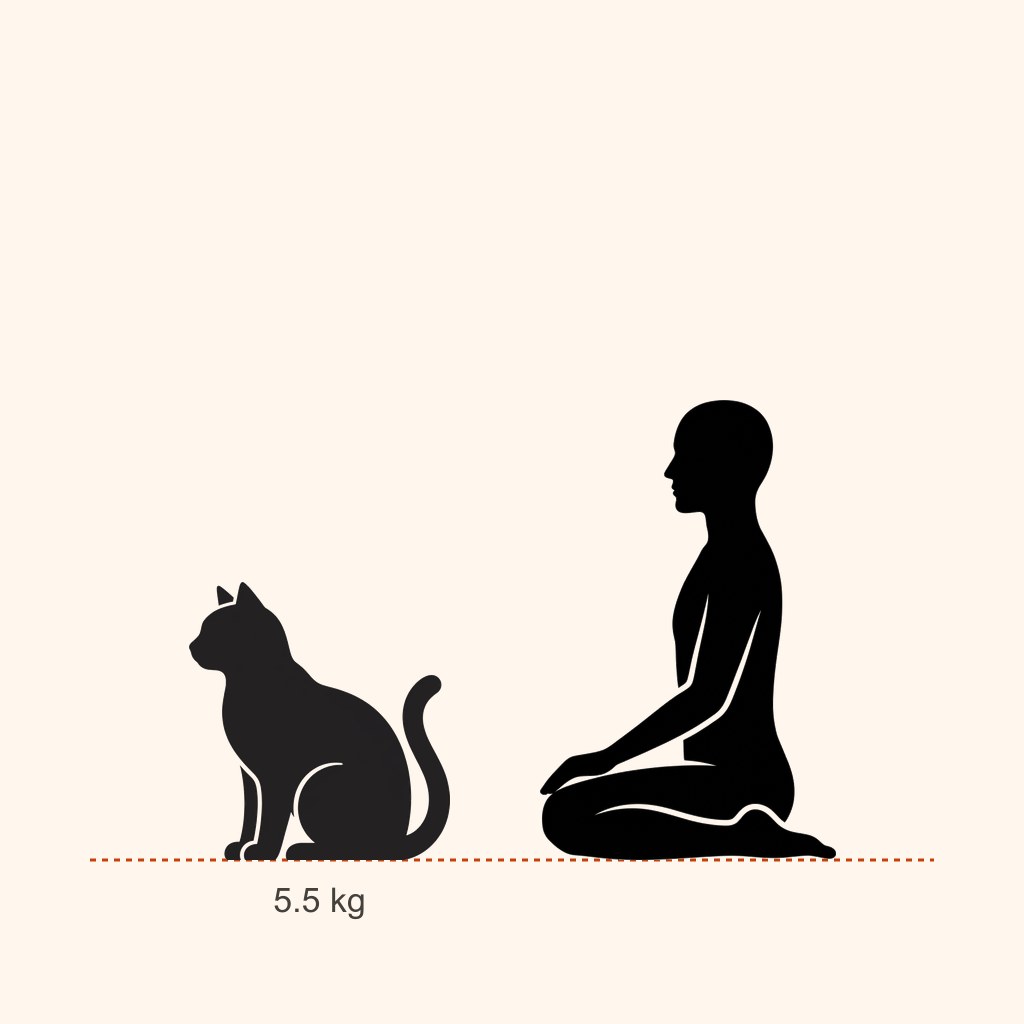
An adult Norwegian Forest Cat (4-9 kg; males are markedly larger) needs the energy equivalent of 65-100 g of dry food per day.
- Kitten (2-18 months): Kitten food. This breed grows very slowly; an extended kitten period or a large-breed formula should be used and the switch should not be made early.
- Adult: High protein, low carbohydrate. Omega-3 content matters for coat quality.
- Senior (10+ years): Annual monitoring of kidney and cardiac values.
Food and water bowls should be wide and shallow; a large cat squashes its whiskers in a narrow bowl.
A fountain-type water bowl helps with water intake.
Grooming and coat
A water-repellent double coat. It is dense but mats less readily than the Maine Coon's.
- Brush two to three times a week; daily in spring. This breed sheds its winter coat all at once in spring, and during that period the house fills with hair.
- An undercoat rake is needed during seasonal changes.
- Matting risk is highest in the armpits, under the belly, on the ruff, and on the inner rear legs.
- The tail is very plumed and should be brushed.
- Bathing is generally unnecessary; the coat is so water-repellent that even wetting it is difficult.
- Nails every two to three weeks; this cat climbs a great deal.
- Teeth several times a week.
- A wide litter tray is needed; standard trays are inadequate for a large cat.
Living space and enrichment
The household layout for this breed should be built vertically:
- A tall, sturdy cat tree. A structure reaching near the ceiling that will carry an 8 kg cat. For this breed it is a need, not a luxury.
- Wall shelves and climbing routes. A cat that lives in trees in the wild; the need for vertical movement is real.
- A solid scratching post. Tall and vertical; it should be able to stretch to full length.
- Play twice a day. Wand toys, hunting simulation.
- A cool corner. A cool room and ceramic flooring in summer; the thick coat struggles in heat.
- A safe window. A screen is essential; this breed jumps.
- Indoors. For safety and for wildlife, it should not be let out freely.
History
The Norwegian Forest Cat is a native breed that developed naturally in Scandinavia over centuries. Its Norwegian name is "Norsk Skogkatt". Harsh winter conditions selected for a water-repellent outer coat, a dense undercoat, furry paws that make walking on snow easier, and powerful climbing ability.
The breed appears in Norwegian folklore and in Viking-era narratives; the cats said to pull the goddess Freyja's chariot are claimed to be of this breed. It is suggested that it travelled on Viking ships as a rat catcher and may in that way have reached North America and become one of the ancestors of the Maine Coon; this is a hypothesis, not a proven fact.
In the middle of the 20th century the breed came close to extinction through interbreeding with street cats. Norwegian enthusiasts began conservation work in the 1930s, the Second World War interrupted it, and it resumed in the 1970s.
King Olav V declared it the national cat of Norway in 1972. FIFe recognised it in 1977, and the first individuals left the country in the same year.
This guide is for information only and is not a substitute for veterinary advice. Prices are approximate and vary by region and time.
Adoption Prep Checklist
Housing
-
Cat bed
Cats want a safe space of their own to rest.
-
Cat scratching post
Satisfies the natural scratching instinct and protects furniture.
Feeding
-
Dry/wet cat food
Quality cat food is needed for balanced nutrition.
-
Food and water bowl set
Needed for daily feeding and water access.
Grooming
-
Cat litter and litter box
Essential for the cat's toilet needs.
-
Cat de-shedding brush
Regular brushing reduces hairball formation.
Activity
-
Cat toy
Cats release energy through play.
-
Cat carrier
Needed for safe transport to vet visits.
Frequently Asked Questions
Does the Norwegian Forest Cat shed?
It sheds a moderate amount. Brushing two or three times a week noticeably reduces both loose hair and matting.
Can the Norwegian Forest Cat live in an apartment?
Yes. It lives comfortably in an apartment as long as its daily needs are met. What matters is not floor area but consistent exercise and mental stimulation.
Is the Norwegian Forest Cat good with children?
Generally yes. It adapts well to families with children. Even so, interactions should be supervised and children taught to respect the animal’s boundaries.
Is the Norwegian Forest Cat suitable for first-time cat owners?
Yes. Its care and training are relatively forgiving, which makes it a sound choice for first-time owners.
How much exercise does the Norwegian Forest Cat need?
It needs a moderate amount of exercise. Daily activity plus some play time makes for a balanced routine.
Can the Norwegian Forest Cat be left alone during the day?
It can be left alone for a few hours. Long, routine absences can bring on boredom-driven behaviour problems; enrichment and a predictable routine reduce that risk.
How long does the Norwegian Forest Cat live?
The Norwegian Forest Cat lives 12 - 16 years on average. Diet, regular veterinary check-ups and early screening for hereditary conditions all affect this directly.
Where does the Norwegian Forest Cat come from?
The Norwegian Forest Cat originates from Norway. The geography a breed was developed in, and the job it was bred for, explain much of its temperament and care needs today.