

Ginger Tabby Cat
The image on this page is AI-generated and does not depict a real animal.
- Species
- Cat
- Origin
- Turkey and worldwide (mixed breed)
- Size
- Medium
- Lifespan
- 12-18 years
- Temperament
- Affectionate friendly playful generally adaptable
- Description
Known for its orange/ginger coat, called "sarman" in Turkey, this widely recognized cat type does not belong to a specific breed and is commonly seen both on the streets and in homes.
- Physical Traits
Orange-yellow toned coat, usually with a tabby pattern; medium build, sturdy body; this color is more commonly seen in males.
- Care / Environment Info
Lives indoors and adapts easily to a litter box. Since it's usually short-haired, shedding is moderate and it doesn't produce odor. Thanks to its mixed genetic makeup, it is generally hardy and healthy. For street-origin individuals, checking vaccination, internal/external parasite treatment, and spay/neuter status before adoption is important.
Ginger Tabby Cat Owner's Guide
Last updated:
Is an orange (ginger) cat right for you?
"Ginger" or "orange" describes a coat colour, not a breed. Almost all the orange cats you meet in streets and shelters are random-bred domestic cats without a pedigree. Orange also appears in many breeds such as the Persian, Maine Coon or British Shorthair, but this page is written for people adopting mixed-breed ginger cats.
Orange cats come with popular beliefs attached: "more affectionate", "greedier". None of this is scientifically established; a cat's character is shaped by its history and socialisation, not its colour.
| Situation | Suitability | Note |
|---|---|---|
| Apartment | Very good | Window netting and climbing space are essential |
| Family with young children | Depends on the cat | Choose a calm adult that has met children |
| First-time cat owner | Very good | An adult with a known personality is the easiest start |
| Alone 8+ hours a day | Good | Adults adapt; hard for kittens |
| Home with cat allergies | Poor | Colour does not change allergen output |
| Other cats already at home | Depends on the cat | FeLV/FIV test first, then a slow introduction |
| Free outdoor access | Not recommended | Risk of fights, traffic and infectious disease |
Before you adopt
A cat from a shelter, rescue or the street usually comes with an unknown past. Get to a vet within the first week and cover these steps:
- General exam and age estimate: Teeth, weight, ear mites, eye and nasal discharge, skin.
- FeLV and FIV testing: Recommended for every newly adopted cat. Unneutered adult males with bite-wound scars are the highest-risk group for FIV, and since most ginger cats are male this test matters even more. A positive result in a kitten under six months can come from maternal antibodies and needs retesting.
- Parasite treatment and vaccines: An adult with an unknown history is treated as unvaccinated and started on core vaccines.
- Neutering: Reduces urine marking, fighting and roaming in males and prevents unwanted litters in females.
- Microchip and registration: Required or recommended in many countries; in Turkey, for example, owned cats must be microchipped and registered in the national PETVET system.
If you have other cats, keep the newcomer in a separate room until test results are in. Abandoning an owned animal is illegal in many countries; treat adoption as a lifelong commitment.
Temperament
The belief that orange cats are friendlier or more laid-back is widespread, but no strong scientific study backs it up. There is also a likely confounder: most ginger cats are male, and neutered males are known in many homes for their relaxed, people-oriented nature. Any difference people notice may come from sex and living conditions rather than colour.
What really makes the difference:
- How much human contact the cat had as a kitten.
- How long it lived on the street without people.
- How calm and predictable its first weeks in your home are.
An adult ginger with a street past may hide or avoid touch at first. That is normal; build trust with food and play rather than force.
Health issues and lifespan
Orange colour is not a cause of disease in itself. For cats from the street or a shelter, watch for:
- FIV and FeLV: FIV spreads mainly through bites, so fighting males are at higher risk. FIV-positive cats can live well for a long time in a calm household without fighting.
- Lentigo (black freckles): Flat black spots on the lips, nose and eyelid margins are common in orange cats from middle age and are harmless. Have a spot checked if it becomes raised, bleeds, ulcerates or grows quickly.
- Obesity: Weight gain is common, especially in neutered males. If you can't feel the ribs with light pressure, review portions.
- Urinary blockage in males: A male cat going to the litter box often and passing little urine, straining or crying is an emergency; see a vet the same day.
- Dental and gum disease: Bad breath, drooling, chewing on one side.
- Parasites and ringworm: Itching, round patches of hair loss; ringworm can spread to people.
Lifespan is driven by living conditions, not colour. Indoor mixed-breed cats that are vaccinated, neutered and kept at a healthy weight often live past fifteen.
Feeding
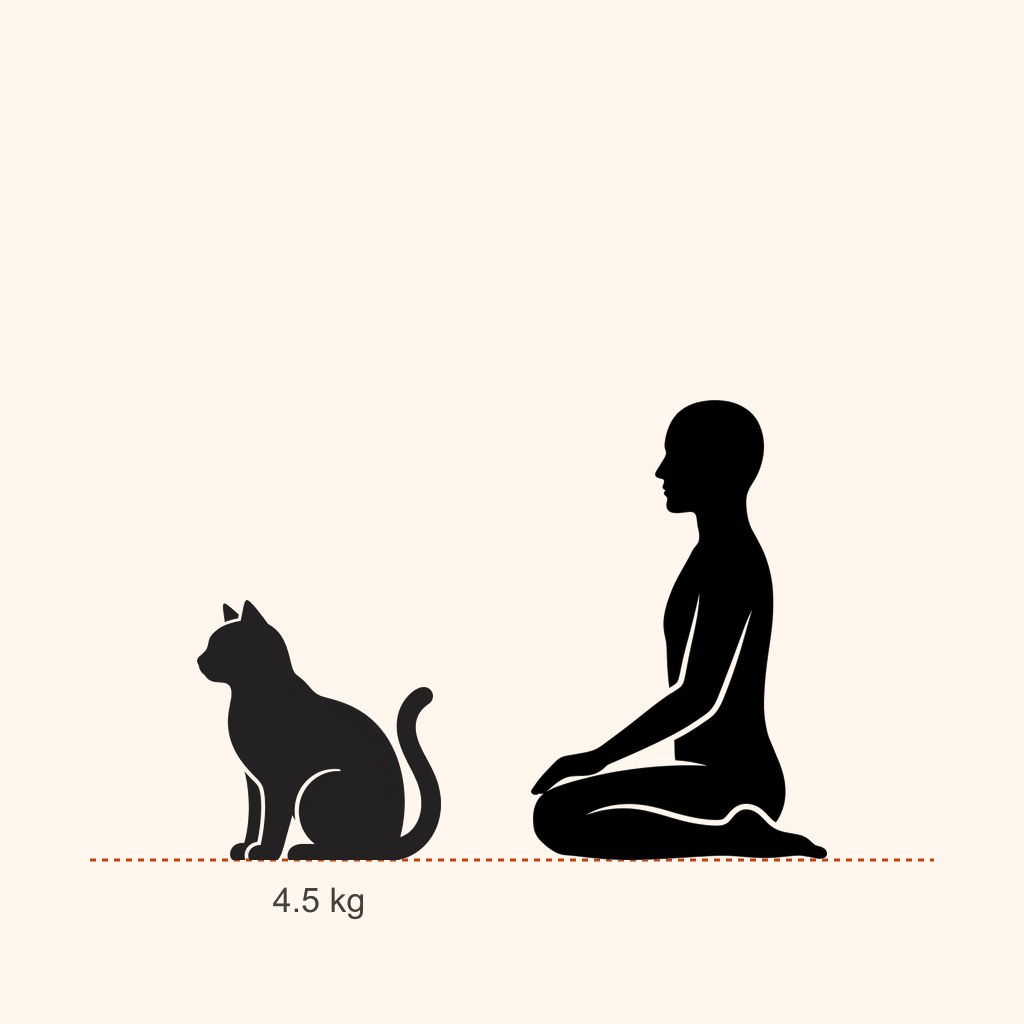
Adult mixed-breed ginger cats usually weigh 3.5-5.5 kg; males are generally larger than females.
- Kitten (2-12 months): Kitten food, 3-4 meals a day. No cow's milk.
- Adult: Meat-based complete food; start with the chart on the pack and adjust to body condition.
- Neutered male: Lower energy needs. Split food across the day and weigh it rather than guessing.
- Underweight street cat: Build up to normal portions over a few days with small, frequent meals.
Water intake supports urinary health in male cats: use wet food, a drinking fountain and water bowls in several places. Onion, garlic, chocolate and grapes are not suitable for cats.
Grooming and coat
Most mixed-breed ginger cats are shorthaired.
- Brushing once or twice a week with a rubber mitt or soft brush is enough.
- Orange hair shows up clearly on light clothes and sofas; how much a cat sheds depends on season and coat type, not colour.
- While brushing, check the freckles around lips and nose, and look for wounds or scabs.
- Check nails every 2-3 weeks and ears weekly.
Living space and enrichment
- A safe room for the first days. Litter box, water, food and a hiding box.
- Window netting. Former street cats may try to get out; an open window in summer is a fall risk.
- Vertical space. Cat trees and shelves build both activity and confidence.
- Two play sessions a day. 10-15 minutes of hunting play with a wand toy also helps with weight control.
- Food puzzles. Serving part of the dry food in puzzle feeders adds mental work and slows eating.
- Keeping cool in summer. A cool spot and several water bowls.
The genetics of orange colour
The gene that makes cats orange sits on the X chromosome. That single fact explains the most common question about ginger cats: why are most of them male?
- Males (XY) have one X. If that X carries the orange variant, the cat is orange.
- Females (XX) need the orange variant on both X chromosomes to be fully orange. Females with one copy show a mix of orange and black patches, because one X is randomly switched off in each cell: they become tortoiseshell, or calico if white is added.
That is why a clear majority of orange cats are male. Vet-reviewed sources commonly give the figure as roughly 80% male. The ratio is not fixed: it depends on how common the orange variant is in a local cat population. The more common the gene, the more likely you are to see orange females.
The reverse also holds: a male calico or tortoiseshell cat is very rare. These cats usually have an XXY chromosome make-up and, according to the Merck Veterinary Manual, are sterile.
The gene itself long remained a mystery. In 2025 two independent teams, at Stanford and Kyushu universities, published in Current Biology that orange colour is linked to a small DNA deletion at the ARHGAP36 gene on the X chromosome. The deletion pushes pigment cells to make orange rather than black pigment, and researchers report that it appears in no other mammal.
Finally, tabby stripes are almost always visible on ginger cats. The gene that hides the tabby pattern in solid-coloured cats does not act on orange pigment, so even a cat that looks "plain orange" shows faint stripes if you look closely.
This guide is for information only and is not a substitute for veterinary advice. Prices are approximate and vary by region and time.
Sources
- www.sciencedaily.com/releases/2025/05/250515131453.htm
- en.wikipedia.org/wiki/Ginger_cat
- www.merckvetmanual.com/multimedia/table/calico-and-black-and-orange-tortoiseshell-cats
- www.chewy.com/education/cat/training-and-behavior/behavior-pet-facts-are-all-orange-cats-male-all-calico-cats-female
- www.vet.cornell.edu/departments-centers-and-institutes/cornell-feline-health-center/health-information/feline-health-topics/feline-immunodeficiency-virus
- www.tarimorman.gov.tr/Haber/5652/Sahipli-Hayvanlarin-Dijital-Kimliklendirilmesi
Adoption Prep Checklist
Housing
-
Cat bed
Cats want a safe space of their own to rest.
-
Cat scratching post
Satisfies the natural scratching instinct and protects furniture.
Feeding
-
Dry/wet cat food
Quality cat food is needed for balanced nutrition.
-
Food and water bowl set
Needed for daily feeding and water access.
Grooming
-
Cat litter and litter box
Essential for the cat's toilet needs.
-
Cat de-shedding brush
Regular brushing reduces hairball formation.
Activity
-
Cat toy
Cats release energy through play.
-
Cat carrier
Needed for safe transport to vet visits.
Frequently Asked Questions
Does the Ginger Tabby Cat shed?
It sheds a moderate amount. Brushing two or three times a week noticeably reduces both loose hair and matting.
Can the Ginger Tabby Cat live in an apartment?
Yes. It lives comfortably in an apartment as long as its daily needs are met. What matters is not floor area but consistent exercise and mental stimulation.
Is the Ginger Tabby Cat good with children?
Generally yes. It adapts well to families with children. Even so, interactions should be supervised and children taught to respect the animal’s boundaries.
Is the Ginger Tabby Cat suitable for first-time cat owners?
Yes. Its care and training are relatively forgiving, which makes it a sound choice for first-time owners.
How much exercise does the Ginger Tabby Cat need?
It needs a moderate amount of exercise. Daily activity plus some play time makes for a balanced routine.
Can the Ginger Tabby Cat be left alone during the day?
It can be left alone for a few hours. Long, routine absences can bring on boredom-driven behaviour problems; enrichment and a predictable routine reduce that risk.
How long does the Ginger Tabby Cat live?
The Ginger Tabby Cat lives 12-18 years on average. Diet, regular veterinary check-ups and early screening for hereditary conditions all affect this directly.
Where does the Ginger Tabby Cat come from?
The Ginger Tabby Cat originates from Turkey and worldwide (mixed breed). The geography a breed was developed in, and the job it was bred for, explain much of its temperament and care needs today.