

Selkirk Rex
The image on this page is AI-generated and does not depict a real animal.
- Species
- Cat
- Origin
- United States
- Size
- Medium
- Lifespan
- 14-20 years
- Temperament
- Active Affectionate Devoted (attached to its owner) Gentle Patient Playful Quiet Social
- Description
Extremely patient, affectionate and tolerant; also has a somewhat playful, clownish streak.
- Physical Traits
Curly/wavy, plush coat (short or long), an overall teddy-bear-like look.
- Care / Environment Info
Lives indoors. Sheds very little. Easy to care for, brushing once a week is enough. Moderate energy. Moderately vocal/talkative. Its allergy-triggering potential is considered somewhat lower than other breeds (not fully hypoallergenic). Regular veterinary checkups and breed-specific health monitoring are important.
Selkirk Rex Owner's Guide
Last updated:
Is a Selkirk Rex right for you?
The Selkirk Rex, often called "the cat in sheep's clothing", is a large breed known for its thick, loosely curled coat. Unlike the fine, sparse curls of the Cornish and Devon Rex, the Selkirk's coat is dense, and it comes in shorthair and longhair varieties. The breed began with a spontaneous mutation in a rescued cat and was developed with Persian, British Shorthair and Exotic outcrosses. That heritage gave it a calm temperament and, on the health side, the inherited risks of those breeds, such as PKD and HCM, which need screening.
| Situation | Suitability | Note |
|---|---|---|
| Apartment | Perfect | A calm, adaptable indoor cat |
| Family with young children | Perfect | Patient and gentle-natured |
| First-time cat owner | Good | Easy temperament; the coat has its own rules to learn |
| Alone 8+ hours a day | Moderate | Easier thanks to its British heritage, but it still wants company |
| Household with fur allergies | Poor | Dense coat that sheds; "rex" does not mean allergy-friendly |
| Home with other pets | Good | CFA notes it is gentle with other animals |
| Owner who likes to brush often | Moderate | Over-combing ruins the curls; care should be "less but right" |
The most realistic question: when choosing a kitten, can you ask for the parents' PKD and HCM screening results and wait for the right litter? The Selkirk's temperament is easy; the part that needs care is finding a kitten from a healthy line.
Before you adopt
The Selkirk Rex's health risks largely come from the breeds used to develop it. CFA states there are no breed-specific health concerns, but breeders screen for conditions in the parent breeds: polycystic kidney disease (PKD), hip dysplasia, hypertrophic cardiomyopathy (HCM) and blood type incompatibility.
- PKD genetic test: According to Wikipedia, PKD testing is mandatory for Selkirk Rex breeders in the UK. Always see the parents' results.
- HCM screening: There is no single genetic test covering all breeds for HCM; ask about the parents' echocardiography history.
- Blood type: Type B blood occurs in British and Persian-derived lines. It must be known for breeding, and it is useful information for your own cat should a transfusion ever be needed.
- Straight-coated kittens: The curl gene is dominant, but some kittens in the same litter can be born straight-coated. They have the same temperament.
Do not decide without papers and test results.
Temperament
According to CFA, the Selkirk Rex reflects the temperaments of the breeds used to create it: the laid-back British Shorthair, the cuddly Persian and the impish playfulness of the Exotic.
CFA describes it as "more interactive than active". It bonds strongly with its people and answers back when spoken to, though it is not especially vocal. It enjoys laps.
PetMD describes a patient, easygoing and loving cat that fits well with families with children and other animals. It wants company and enjoys interactive play and cuddles.
Its energy level is moderate to low. A few short play sessions a day keep it happy, and it is not a cat that turns the house upside down.
Health issues and lifespan
PetMD gives 14 to 20 years; sources generally cite 14 years or more. Things to watch:
- Polycystic kidney disease (PKD): PetMD reports a moderate risk in this breed because of Persian and British Shorthair ancestry. Cysts grow in the kidneys over time and can lead to kidney failure. If you see increased drinking and urination, weight loss, poor appetite or vomiting, ask for blood and urine tests and an ultrasound. An untested cat can be screened by ultrasound.
- Hypertrophic cardiomyopathy (HCM): Thickening of the heart wall. PetMD lists shortness of breath, lethargy, loss of appetite and weight, and blue or white gums. Open-mouth breathing or sudden hind-leg paralysis is an emergency. The heart should be listened to at annual checks.
- Progressive retinal atrophy (PRA): According to PetMD a low-risk eye condition inherited from Persian ancestry. Trouble seeing at night, bumping into objects and dilated pupils are signs.
- Oily skin and coat: PetMD notes the skin may be oily, and Wikipedia reports excessive greasiness especially in cats with two copies of the curl gene. A sticky coat, bad smell or red skin warrants a vet visit.
- Obesity: Large and calm, it gains weight easily; an ideal weight matters even more in a breed at risk of PKD and HCM.
Annual checks are recommended, with blood and urine tests including kidney values after age 7 to 8.
Feeding
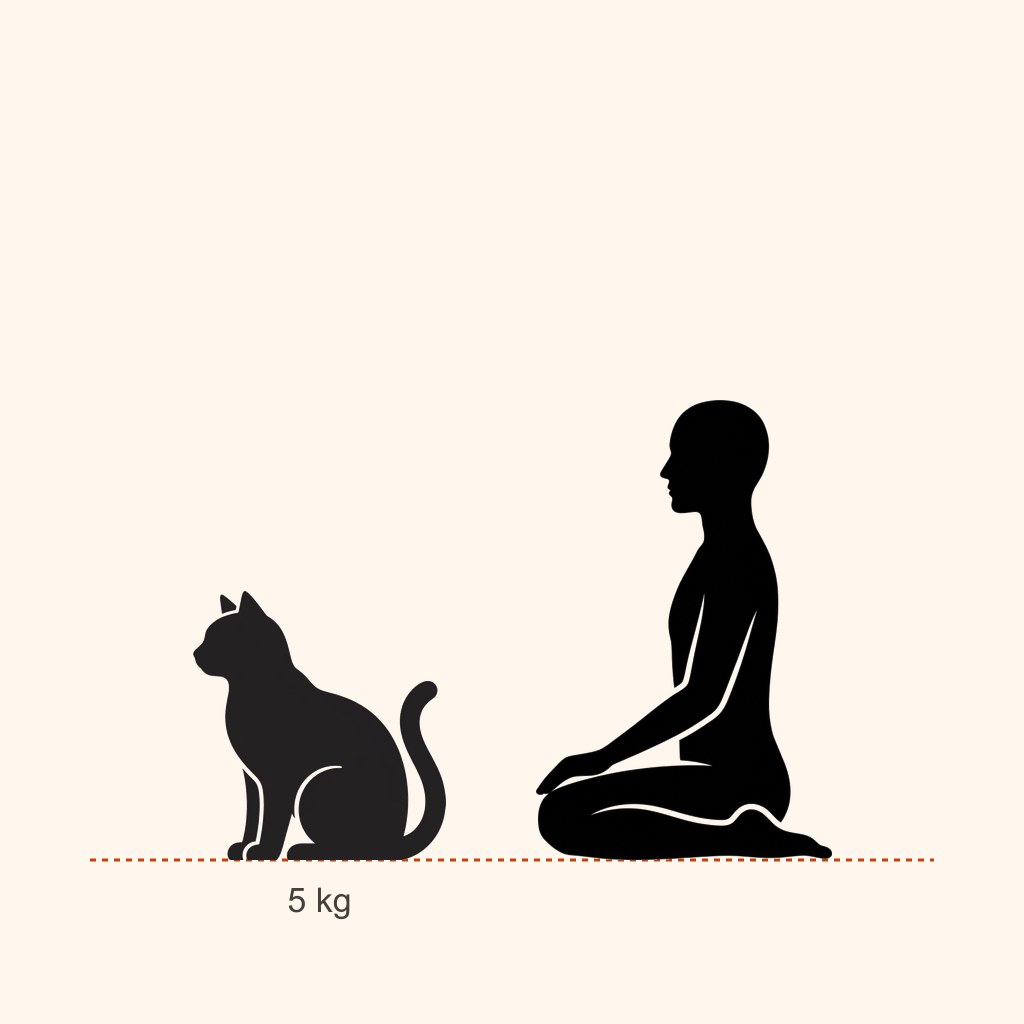
The Selkirk Rex is a medium-to-large, muscular cat. According to Wikipedia, males may reach around 5.5 to 7 kg; females are lighter.
- Kitten (2-12 months): Kitten food, 3 to 4 meals a day.
- Adult: Quality, high-protein food; 2 to 3 measured meals a day. Avoid free feeding.
- After neutering: Energy needs drop; weigh monthly.
- Senior (10+ years): A diet set with your vet according to kidney values.
Because of the PKD risk, water intake matters: use wet food, a fountain and several water points. In round-faced individuals with Persian heritage, smaller flat kibble can be easier to pick up.
Grooming and coat
The basic rule: less but right. Over-combing straightens the curls and leaves a fluffy, untidy look.
- Shorthair: CFA says no special tools are needed; gentle fingertip scratching fluffs the curls. Monthly combing removes dead hair.
- Longhair: Gentle combing once or twice a week with a wide-toothed comb to prevent mats.
- Shedding: Selkirks do shed; comb more often at season changes.
- Bathing: Every few weeks for cats with oily coats. Afterwards blot dry with a towel rather than brushing; the curls reform on their own. Make sure the coat dries completely.
- Ears: Check weekly; clean with a solution your vet recommends if needed.
- Whiskers: Curly whiskers break easily; this is normal.
- Nails every 2 to 3 weeks; teeth several times a week.
Living space and enrichment
- Comfortable resting places. Soft beds and low, wide platforms.
- Daily play. Two 10 to 15 minute sessions a day; it also helps weight control.
- A sturdy cat tree. Medium height, able to hold a heavy cat.
- Cool summers. A cool room and plenty of water for this dense-coated breed in hot weather.
- Safe windows and balconies. Fit nets; indoor life is recommended.
History
The Selkirk Rex story began with a litter connected to an animal shelter in Montana, USA. The curly-coated female kitten from that litter reached breeder Jeri Newman, who named her "Miss DePesto". CFA dates this to 1986, Wikipedia to 1987.
Miss DePesto was bred to a black Persian and some of the kittens were born curly, showing that the curl came from a dominant gene, unlike the recessive genes in the Cornish and Devon Rex. According to Wikipedia the gene involved is KRT71. The breed carries the name of Newman's stepfather and is known as the only cat breed named after an actual person.
The gene pool was widened with Persian, Exotic and British Shorthair outcrosses. Under CFA's current rules, kittens from Persian outcrosses were accepted if born before 1 January 2020, and those from British Shorthair or Exotic outcrosses if born before 1 January 2025. CFA accepted the breed for registration in 1992 and granted championship status in 2000.
This guide is for information only and is not a substitute for veterinary advice. Prices are approximate and vary by region and time.
Adoption Prep Checklist
Housing
-
Cat bed
Cats want a safe space of their own to rest.
-
Cat scratching post
Satisfies the natural scratching instinct and protects furniture.
Feeding
-
Dry/wet cat food
Quality cat food is needed for balanced nutrition.
-
Food and water bowl set
Needed for daily feeding and water access.
Grooming
-
Cat litter and litter box
Essential for the cat's toilet needs.
-
Short-hair cat brush
Regular brushing reduces hairball formation.
Activity
-
Cat toy
Cats release energy through play.
-
Cat carrier
Needed for safe transport to vet visits.
Frequently Asked Questions
Does the Selkirk Rex shed?
Shedding is low. Brushing once a week is usually enough, with a mild increase during seasonal changes.
Can the Selkirk Rex live in an apartment?
Yes. It lives comfortably in an apartment as long as its daily needs are met. What matters is not floor area but consistent exercise and mental stimulation.
Is the Selkirk Rex good with children?
Generally yes. It adapts well to families with children. Even so, interactions should be supervised and children taught to respect the animal’s boundaries.
Is the Selkirk Rex suitable for first-time cat owners?
Partly. Someone with basic experience will manage well, but it would not be the first choice for a complete beginner.
How much exercise does the Selkirk Rex need?
It needs a moderate amount of exercise. Daily activity plus some play time makes for a balanced routine.
Can the Selkirk Rex be left alone during the day?
It can be left alone for a few hours. Long, routine absences can bring on boredom-driven behaviour problems; enrichment and a predictable routine reduce that risk.
How long does the Selkirk Rex live?
The Selkirk Rex lives 14-20 years on average. Diet, regular veterinary check-ups and early screening for hereditary conditions all affect this directly.
Where does the Selkirk Rex come from?
The Selkirk Rex originates from United States. The geography a breed was developed in, and the job it was bred for, explain much of its temperament and care needs today.