

Mastiff
The image on this page is AI-generated and does not depict a real animal.
- Species
- Dog
- Origin
- England
- Size
- Very Large
- Lifespan
- 6-8 years
- Temperament
- Calm gentle loyal protective
- Description
One of the largest dog breeds in the world; known as a calm and gentle giant.
- Physical Traits
Short dense coat (fawn, red-brown or brindle), a black mask pattern, a massive muscular body.
- Care / Environment Info
A large house/garden is required. Its short coat sheds little, easy to maintain. Low-to-moderate exercise needs. Drooling tendency is noticeable, being a giant breed it has a short lifespan.
Mastiff Owner's Guide
Last updated:
Is a Mastiff right for you?
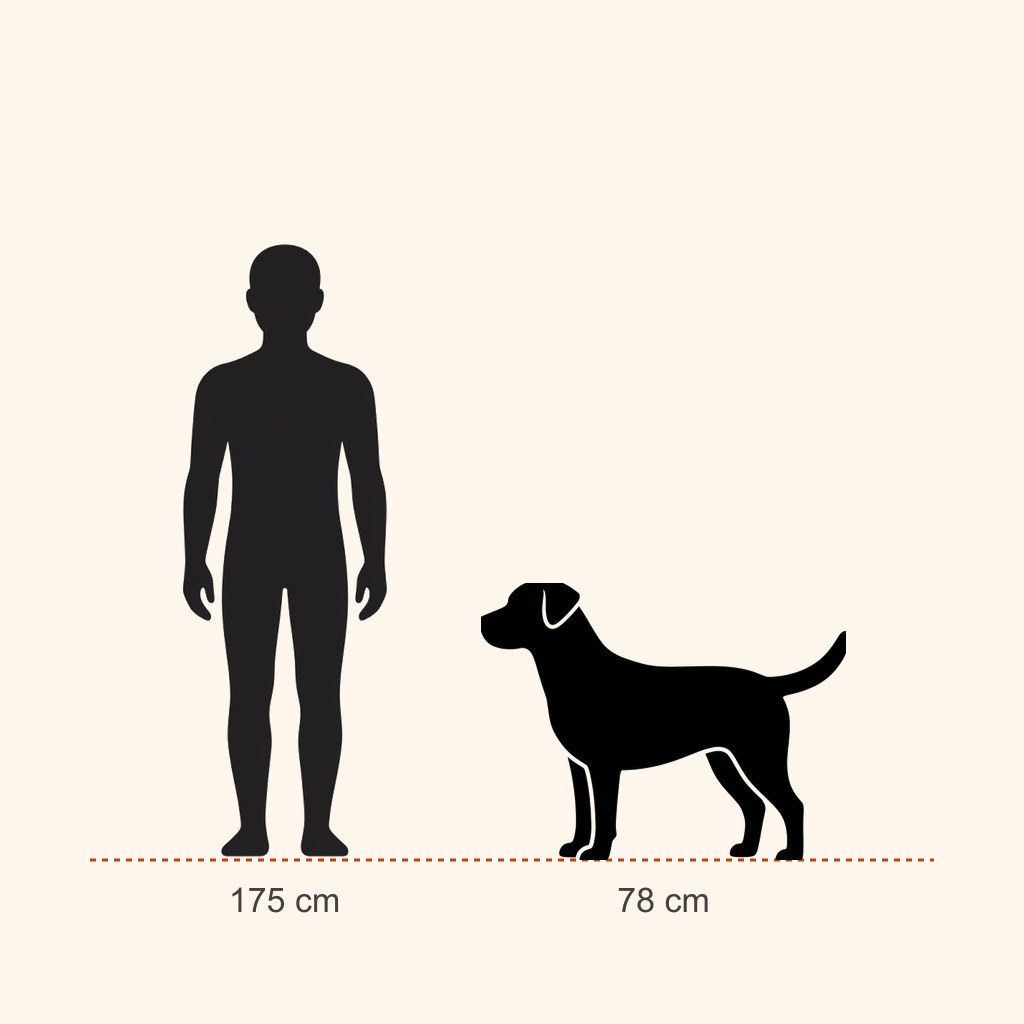
The Mastiff (English Mastiff) is among the heaviest dog breeds in the world. Males commonly stand 76 cm or more at the shoulder and can exceed 90 kg. Inside that huge body lives a surprisingly calm, docile and family-loving dog. But everything scales with it: the food, the drool, the space it takes, the vet bills, and the difficulty of lifting it into a car in an emergency. Like most giant breeds, its life is short.
| Situation | Suitability | Note |
|---|---|---|
| Apartment | Poor | Lazy indoors, but stairs without a lift become impossible as it ages |
| First-time dog owner | Moderate | Easy temperament, but its size magnifies every mistake |
| Family with young children | Caution | Gentle and patient; can knock children over by accident |
| Hot summers, no cool space | Poor | A heavy body and short muzzle struggle quickly in heat |
| Low tolerance for drool and hair | Unsuitable | Drool reaches walls, ceilings and guests |
| Running or active sports | Unsuitable | Not an endurance breed |
| Spacious, cool, calm home | Good | Ideal for a carefully raised Mastiff |
Before you adopt
The Mastiff is not typically subject to breed-specific restrictions (it is not on Turkey's dangerous-breeds list, for instance), but check local rules.
Think practically about whether you can manage a dog this big. Do you have a vehicle that can carry it to the vet? Will someone be able to lift it if it is injured or elderly? Medication and anaesthesia doses are calculated by weight in giant dogs, so health costs rise accordingly.
The Mastiff Club of America's health programme requires hip and elbow evaluations, an eye examination and a cardiac examination for parents. Tests for cystinuria, dominant PRA, multifocal retinopathy (CMR1) and degenerative myelopathy are also recommended. Ask the breeder for these results and see the parents' temperament for yourself; shyness is a fault in the standard.
Temperament
The FCI standard describes the Mastiff as a combination of grandeur and courage: calm, affectionate to its owners, capable of guarding and usually indifferent to strangers. Timidity is unacceptable.
At home it spends much of its time asleep and moves economically. It rarely barks; its presence and voice are deterrent enough. When it senses a threat it tends to place itself in between and block rather than attack.
It is a sensitive breed that is easily hurt by a harsh tone and works willingly for praise and rewards. But because of its size, making it do something it does not want to do is physically impossible, so training depends on habits and cooperation built in puppyhood, not force.
A young Mastiff is clumsy and playful. The enthusiasm of a 60 kg "puppy" can be dangerous for children and older people.
Health issues and lifespan
Sources usually give an average lifespan of 6 to 10 years. The short life of giant breeds reflects not only early ageing but also the frequency of cancer and orthopaedic problems.
- Gastric dilatation-volvulus (bloat): The most feared emergency in deep-chested giants. A swollen, tight belly, unproductive retching, heavy drooling, restlessness and pale gums mean going straight to an emergency vet. The MSD Veterinary Manual recommends preventive gastropexy for at-risk breeds; it prevents twisting but not bloating itself.
- Hip and elbow dysplasia: Lameness, difficulty rising, bunny-hopping. A giant frame quickly turns dysplasia into severe arthritis.
- Cancer: Bone cancer (osteosarcoma), lymphoma, haemangiosarcoma and mast cell tumours are reported. Persistent limb lameness or a swelling on a bone should not be dismissed as a sprain; it needs an X-ray.
- Cystinuria: An inherited kidney defect in which the amino acid cystine passes into the urine and forms bladder stones, mainly in males. Frequent straining, blood in the urine or inability to pass urine is an emergency.
- Eye problems: Entropion, ectropion and dominant PRA. Watering, redness and reluctance in the dark are signs.
- Heart disease: Parent cardiac exams are required because of this risk. Tiring quickly, coughing and fainting need a vet check.
- Degenerative myelopathy: Progressive hind-limb weakness and scuffing in older dogs; risk can be identified by DNA test.
Feeding
Needs vary greatly with size; a 70-90 kg adult may eat roughly 800-1,200 g of quality dry food a day depending on energy density and activity. Giant breeds burn fewer calories relative to their weight, so following the pack chart blindly easily leads to weight gain.
- Puppy (2-24 months): Giant-breed puppy food. Mastiffs finish growing at around two years. Slow growth is the rule: excess calories, calcium supplements and rapid weight gain permanently damage joints.
- Adult: Daily ration split into two or three meals.
- Senior (from 6 years): Reduce calories; manage joint support and weight with your vet.
To reduce bloat risk, avoid one large meal, use a slow-feeder for fast eaters, and limit activity for about an hour before and after meals. Dogs diagnosed with cystinuria need a special diet and plenty of water.
Grooming and coat
- Short, dense coat; weekly brushing. Moderate shedding, heavier at seasonal changes.
- Drool: Keep cloths within reach. A washable mat around the water bowl helps.
- Wipe and dry facial folds daily; trapped moisture leads to odour and infection.
- Trim nails every two to four weeks; if not handled from puppyhood, holding an adult Mastiff's paw becomes hard.
- Check ears weekly.
- Bedding: A thick orthopaedic bed to protect elbows and joints. Giant dogs lying on hard floors can develop elbow calluses and fluid swellings.
- Heat: Cool floors, shade and plenty of water; no outings in the hottest hours.
Training and exercise
Daily requirement: 30-60 minutes of gentle walking and light play. A Mastiff may look lazy, but inactivity speeds up weight and joint problems.
Priorities:
- Early socialisation (8-16 weeks). People, children, sounds and places. A confident, calm adult depends on it.
- Lead walking and "sit-stay". These should be solid before it reaches 40 kg.
- No jumping up. Even affection can cause injury at this size.
- Handling for care. Nails, ears, mouth and paws; this makes future vet exams possible.
- Controlled growth. No stairs, jumping down, long strenuous walks or running until 18-24 months.
Short, enjoyable sessions and plenty of praise work best for this sensitive giant.
History
According to the FCI standard, mastiff-type dogs have existed in Britain for many centuries and were known for courage and guarding long before the Battle of Agincourt in the early 15th century. It is recorded that the invading Romans found mastiff-type dogs in Britain and took some back to fight in Roman arenas.
For centuries they served as estate guardians and hunting dogs, and at times in animal fighting. The standard notes that the breed almost became extinct in Britain after the Second World War and was rebuilt with imported stock.
Today the Mastiff is mostly kept as a calm family dog and guardian. Accepted colours are apricot, fawn and brindle, with a black muzzle, ears and nose.
This guide is for information only and is not a substitute for veterinary advice. Prices are approximate and vary by region and time.
Adoption Prep Checklist
Housing
-
Large-breed dog bed
A comfortable bed supports joint health.
Feeding
-
Large-breed dog food
Food matched to breed size gives the right nutritional balance.
-
Food and water bowl set
Needed for daily feeding and water access.
Grooming
-
Short-hair dog brush
Regular brushing reduces shedding and matting.
-
Dog nail clippers
Regular nail care matters for healthy walking.
-
Dog shampoo
Use a dog-specific shampoo for skin and coat health.
Walking & Activity
-
Dog leash and collar set
Needed for safe walks.
-
Plush dog toy
Mental and physical stimulation reduces behavior problems.
Frequently Asked Questions
Does the Mastiff shed?
Shedding is low. Brushing once a week is usually enough, with a mild increase during seasonal changes.
Can the Mastiff live in an apartment?
Not recommended. It needs a large garden or open space. Kept in confined quarters, restlessness and behavioural problems are the expected outcome.
Is the Mastiff good with children?
Generally yes. It adapts well to families with children. Even so, interactions should be supervised and children taught to respect the animal’s boundaries.
Is the Mastiff suitable for first-time dog owners?
Partly. Someone with basic experience will manage well, but it would not be the first choice for a complete beginner.
How much exercise does the Mastiff need?
Its energy level is low. Short, regular activity is enough; strenuous exercise is not required.
Can the Mastiff be left alone during the day?
It can be left alone for a few hours. Long, routine absences can bring on boredom-driven behaviour problems; enrichment and a predictable routine reduce that risk.
How long does the Mastiff live?
The Mastiff lives 6-8 years on average. Diet, regular veterinary check-ups and early screening for hereditary conditions all affect this directly.
Where does the Mastiff come from?
The Mastiff originates from England. The geography a breed was developed in, and the job it was bred for, explain much of its temperament and care needs today.