

American Staffordshire Terrier
The image on this page is AI-generated and does not depict a real animal.
- Species
- Dog
- Origin
- United States
- Size
- Medium
- Lifespan
- 12-14 years
- Temperament
- Intelligent loyal protective brave
- Description
Known for its strong, muscular build, a breed extremely devoted to its family.
- Physical Traits
Short dense coat (various colors), a broad strong head, a large muscular body.
- Care / Environment Info
A house with a garden is preferred. Its short coat sheds little, easy to maintain. High exercise and early socialization needs. May be subject to BSL restrictions in some countries/cities.
American Staffordshire Terrier Owner's Guide
Last updated:
Is an American Staffordshire Terrier right for you?
The legal reality first: the American Staffordshire Terrier (AmStaff) is restricted in several countries. In Turkey it is on the list of dangerous breeds and cannot be newly acquired; in Spain it requires a potentially-dangerous-dog licence. Check the rules where you live before going further.
The AmStaff is a compact, muscular terrier that is surprisingly strong for its size. The AKC breed standard calls its courage "proverbial". It is loyal and playful with its family, but its reaction to other dogs and its strength demand experience and constant attention from its owner.
| Situation | Suitability | Note |
|---|---|---|
| Countries with breed restrictions | Check the law | Banned in Turkey; licence required in Spain |
| Apartment | Moderate | A well-exercised AmStaff is calm indoors |
| Family with young children | Caution | Generally good with children but can be overprotective; its strength requires supervision |
| First-time dog owner | Not suitable | Can be strong and stubborn; needs firm, reward-based training |
| Home with another dog | Poor | Not friendly towards unfamiliar dogs |
| Home with cats or small pets | Poor | May be a risk to small pets |
| Household with fur allergies | Moderate | Short coat, average shedding |
Before you adopt
Legal status in some countries:
- Turkey: Since a 2021 ministry circular, the AmStaff has been one of six designated dangerous breeds, alongside the American Pit Bull Terrier, Dogo Argentino, Fila Brasileiro, Japanese Tosa and American Bully. Breeding, acquiring, rehoming, selling, gifting and importing them is prohibited. Dogs owned before the ban could be kept only if neutered, microchipped and registered, and they must be muzzled and leashed in public. Under a 2024 amendment, shelter dogs of banned breeds may be euthanised.
- Spain: The American Staffordshire Terrier and its crosses are listed as potentially dangerous dogs; owners need a municipal licence, liability insurance, registration, and a muzzle and short lead in public.
- Elsewhere: Rules range from none to local bans; in the United States they differ by city.
Not the same as the Staffordshire Bull Terrier. Despite the similar name, the English Staffordshire Bull Terrier is a different, smaller breed and is not on Turkey's banned list. Legal treatment of the two can differ.
From a breeder, where legal: The breed club recommends hip evaluation, a cardiologist's heart exam, annual thyroid testing and the NCL-A DNA test for breeding dogs. Ask to see these results for both parents.
Temperament
VCA describes the AmStaff as loyal, fun-loving and playful. Well-socialised dogs are usually fairly friendly with strangers. It wants to be close to its family and does not like being left alone.
It is intelligent but can be stubborn. It responds better to firm but reward-based training than to forceful methods.
It is not friendly towards unfamiliar dogs, and because of instincts rooted in its fighting past, dog parks are not recommended. It may also pose a risk to small pets.
An AmStaff that gets regular exercise is a calm house dog. One without an outlet will burn off energy through destructive chewing and digging.
Health issues and lifespan
Average lifespan is 12 to 14 years.
- Cerebellar ataxia (NCL-A): An inherited, recessive neurological disease specific to the breed. Signs start in adulthood, usually between two and five years: clumsiness and stumbling, loss of balance, falling while moving, abnormal eye movements after head shaking, brief episodes of sudden stiffness. It is progressive and has no cure. A DNA test exists; the breed club advises never breeding two carriers together, so ask the breeder for both parents' results.
- Hip and elbow dysplasia: Lameness, difficulty rising, stiffness after exercise. Large-breed puppy food and a lean weight are protective.
- Autoimmune thyroiditis and hypothyroidism: Weight gain, lethargy, coat and skin problems. The breed club recommends annual thyroid testing for breeding dogs.
- Congenital heart disease: The breed club recommends a cardiologist's exam for breeding dogs. Have your dog examined if you see exercise intolerance, coughing or fainting.
- Obesity: VCA notes a tendency to become slightly overweight; extra weight worsens joint problems.
Feeding
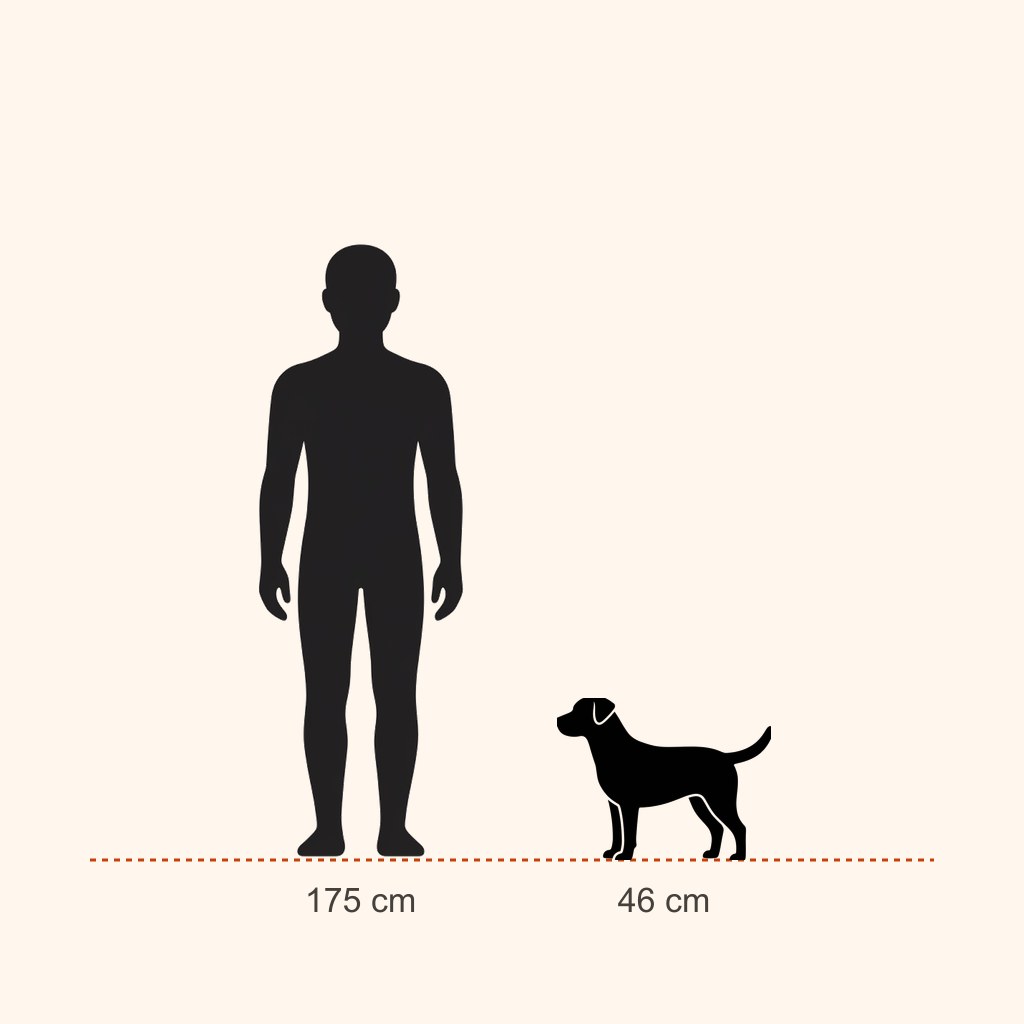
Under the AKC standard, preferred height is about 46-48 cm for males and 43-46 cm for females, with weight in proportion to height; VCA gives an average weight of about 26 kg. An adult of that size eats roughly 300-400 g of quality dry food per day depending on activity.
- Puppy: Large-breed puppy food, as VCA recommends; it slows growth and may reduce the severity of hip dysplasia. Three meals a day.
- Adult: Two measured meals a day. The ribs should be easy to feel and the waist visible.
- Senior (8+ years): Reduce calories and monitor joints.
Energy needs drop after neutering. If there is another dog at home, feed them separately to avoid conflicts over food.
Grooming and coat
Under the AKC standard, the coat is short, close, stiff to the touch and glossy.
- A weekly brush is enough to remove dead hair.
- Bathe as needed; do not wash too often or the skin dries out.
- Nails monthly; getting a strong dog used to nail trims in puppyhood makes life easier.
- Check ears and teeth weekly.
- Summer: Despite the short coat, its muscular build heats up quickly; avoid intense play in the hottest hours.
Training and exercise
Daily requirement: a long walk, short jog or energetic games, about an hour in total. VCA notes that it enjoys activities such as weight pulling and that obedience training is important mental stimulation.
Priorities:
- Obedience training. Sit, wait, leave it, come. In a strong dog, basic cues are safety tools.
- Muzzle training. Legally required in public in some countries. Build it up gradually with rewards.
- Leash control. Sturdy equipment and loose-lead training.
- Dog encounters. Keep a controlled distance and pass calmly. No dog parks.
- Mental work. Scent games and food puzzles.
Harsh methods are both ineffective and risky with this breed. Consistent boundaries and rewards must go together.
History
The AmStaff's roots lie in 19th-century England, in crosses between bulldog-type dogs used for bull-baiting and terriers. These dogs became widespread in America by the mid-1800s.
The American Kennel Club recognised the breed in 1936 as the Staffordshire Terrier, approving its standard the same year. The name was later changed to American Staffordshire Terrier to distinguish it from the smaller English Staffordshire Bull Terrier.
The AmStaff and the American Pit Bull Terrier share the same origins. The AKC line was selected towards show and family dogs, while the UKC-registered Pit Bull line developed separately. Today the two breeds are often named together in legislation, including in Turkey and Spain.
This guide is for information only and is not a substitute for veterinary advice. Prices are approximate and vary by region and time.
Sources
- www.tarimorman.gov.tr/DKMP/Haber/209/Tehlike-Arz-Eden-Hayvanlara-Iliskin-Genelge
- www.dkbb.gov.tr/wp-content/uploads/2024/08/Degisiklikler-Tablosu.pdf
- vcahospitals.com/know-your-pet/dog-breeds/american-staffordshire-terrier
- www.genomia.cz/en/test/ncl-a/
- cdn.akc.org/Marketplace/Health-Statement/American-Staffordshire-Terrier.pdf
- www.boe.es/buscar/act.php?id=BOE-A-2002-6016
Adoption Prep Checklist
Housing
-
Medium-breed dog bed
A comfortable bed supports joint health.
Feeding
-
Medium-breed dog food
Food matched to breed size gives the right nutritional balance.
-
Food and water bowl set
Needed for daily feeding and water access.
Grooming
-
Short-hair dog brush
Regular brushing reduces shedding and matting.
-
Dog nail clippers
Regular nail care matters for healthy walking.
-
Dog shampoo
Use a dog-specific shampoo for skin and coat health.
Walking & Activity
-
Running/exercise dog harness
Needed for safe walks.
-
Interactive dog puzzle toy
Mental and physical stimulation reduces behavior problems.
Frequently Asked Questions
Does the American Staffordshire Terrier shed?
Shedding is low. Brushing once a week is usually enough, with a mild increase during seasonal changes.
Can the American Staffordshire Terrier live in an apartment?
Possible but not ideal. A house with outdoor space is preferable; in an apartment you will need to increase daily exercise substantially.
Is the American Staffordshire Terrier good with children?
Generally yes. It adapts well to families with children. Even so, interactions should be supervised and children taught to respect the animal’s boundaries.
Is the American Staffordshire Terrier suitable for first-time dog owners?
Partly. Someone with basic experience will manage well, but it would not be the first choice for a complete beginner.
How much exercise does the American Staffordshire Terrier need?
It is high-energy and needs vigorous daily activity. Mental stimulation matters as much as physical exercise; without enough to do, destructive behaviour follows.
Can the American Staffordshire Terrier be left alone during the day?
It can be left alone for a few hours. Long, routine absences can bring on boredom-driven behaviour problems; enrichment and a predictable routine reduce that risk.
How long does the American Staffordshire Terrier live?
The American Staffordshire Terrier lives 12-14 years on average. Diet, regular veterinary check-ups and early screening for hereditary conditions all affect this directly.
Where does the American Staffordshire Terrier come from?
The American Staffordshire Terrier originates from United States. The geography a breed was developed in, and the job it was bred for, explain much of its temperament and care needs today.